
Cyber Resilience for Small and Medium Businesses: A Brief Journey
Introduction
In today’s rapidly changing digital landscape, small and medium-sized businesses (SMBs) find themselves navigating a perilous world of evolving cyber threats. While many SMBs consider themselves less likely to be targeted by cybercriminals than larger corporations, recent statistics reveal a different reality. A 2023 Verizon Data Breach Investigations Report (DBIR) report highlights that nearly 61% of all breaches affected smaller organizations, reflecting a dramatic increase in attacks aimed at SMBs (Verizon, 2023). Moreover, according to the Ponemon Institute’s 2022 study, more than 70% of SMBs experienced at least one security incident over the past year (Ponemon Institute, 2022). Such incidents encompass a variety of threats, including ransomware, phishing attacks, insider threats, and supply chain vulnerabilities. These can result in data theft, financial loss, and operational disruptions. In cybersecurity, resilience refers to a business’s capacity to endure, respond to, and recover from cyber incidents. These numbers underscore the fact that cyber threats are not limited to large enterprises. SMBs, which often lack dedicated cybersecurity staff and comprehensive defenses, present an attractive target for attackers.
From ransomware and phishing attacks to insider threats and supply chain vulnerabilities, cybercriminals exploit gaps in security, often resulting in data theft, financial loss, and operational disruption. For example, a ransomware attack could lock SMBs out of their systems, halting operations and leading to significant revenue loss. Statistics show that the average data breach cost for an SMB now exceeds $120,000 – a financial hit that many small businesses struggle to recover from (IBM Security, 2023).
Industries such as healthcare, finance, and retail are particularly vulnerable due to the high-value personal and financial data they handle. However, any industry can be targeted; attackers are indiscriminate when they spot exploitable weaknesses. The Cybersecurity and Infrastructure Security Agency (CISA) has highlighted that many ransomware attacks now target smaller organizations, as they often lack advanced backup and recovery solutions (CISA, 2022). For SMBs, these attacks can have a long-lasting impact on customer trust and brand reputation, sometimes resulting in irreversible damage.
Building cyber resilience is thus more than just installing antivirus software or implementing firewalls; it is a comprehensive, strategic approach that prepares businesses to withstand, respond to, and recover from cyber incidents. Cyber resilience integrates proactive defense measures, risk management, and recovery strategies to ensure that critical functions can continue in the face of cyber disruptions. For SMBs, investing in resilience offers a cost-effective pathway to protect against the growing threat landscape, safeguarding not only their assets and data but also the trust of their customers.
Why Cyber Resilience Matters for SMBs
- High Target, Limited Resources: SMBs often think they are less likely to be targeted. However, limited resources make them appealing targets, as attackers assume they lack robust defenses (Ponemon Institute, 2022).
- The Cost of a Breach: For SMBs, a single breach can be financially devastating. Studies indicate that many small businesses struggle to recover after a cyber attack due to the financial and operational impacts (Verizon, 2023).
- Resilience Beyond Protection: Unlike traditional cybersecurity, resilience prepares a business to withstand and recover from attacks, emphasizing operational continuity even in the face of threats (NIST, 2022).
Steps to Building Cyber Resilience in Your Business
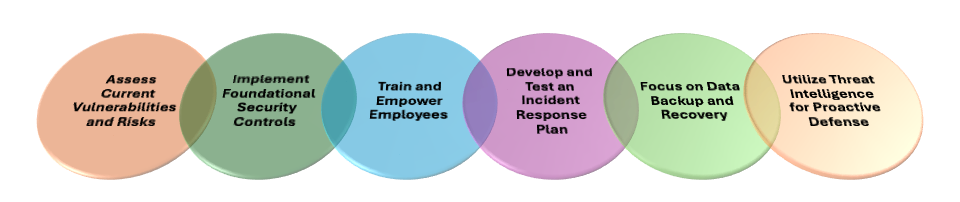
- Assess Current Vulnerabilities and Risks
- Conduct a Risk Assessment: Identify and evaluate the critical assets, systems, and data crucial to your business operations (NIST, 2022).
- Prioritize Risks Based on Impact: Focus on high-impact vulnerabilities first, which can cause the most disruption.
- Identify Internal and External Threats: Understand the threats specific to your industry and business model, including potential insider risks and supply chain vulnerabilities (SANS Institute, 2023).
- Implement Foundational Security Controls
- Firewall and Antivirus Protections: Install and regularly update firewall and antivirus software to create a first line of defense (CISA, 2022).
- Patch Management: Regularly update all software, including operating systems, to protect against known vulnerabilities (Symantec, 2023).
- Secure Access Control: Use multi-factor authentication (MFA) for all critical systems and data (Microsoft Security, 2022).
- Train and Empower Employees
- Cybersecurity Awareness Programs: Regularly educate employees on recognizing phishing attacks, social engineering tactics, and other common threats (Cyber Readiness Institute, 2022).
- Empower a Cyber-Resilient Culture: Encourage suspicious activity reporting and establish a culture of accountability and proactive security measures (Institute for Business and Home Safety, 2023).
- Develop and Test an Incident Response Plan
- Define Key Roles and Responsibilities: Clarify who is responsible for specific actions during an incident, ensuring everyone knows their part (Gartner Research, 2023).
- Prepare Communication Protocols: Set up internal and external communication plans, including notifying clients and stakeholders as appropriate.
- Conduct Regular Drills: Test the plan through simulations to identify weaknesses and improve response times (ISACA, 2023).
- Focus on Data Backup and Recovery
- Automated Data Backups: Ensure critical data is backed up regularly and stored securely offsite or in the cloud (NCSC, 2022).
- Verify Recovery Procedures: Test data recovery processes to ensure they work effectively and within an acceptable time frame (IBM Security, 2023).
- Consider Data Encryption: Encrypt sensitive data at rest and in transit to mitigate data breaches (IBM Security, 2023).
- Utilize Threat Intelligence for Proactive Defense
- Monitor Threat Intelligence Feeds: Integrate threat intelligence to stay aware of evolving threats, especially those targeting SMBs (McAfee, 2023).
- Leverage Automated Tools: Tools like security information and event management (SIEM) systems can help analyze data for signs of attacks in real time (SecurityWeek, 2023).
- Partner with Cybersecurity Experts: For SMBs with limited resources, working with cybersecurity providers (like PixaSec) can provide access to tools and expertise usually only available to larger businesses (Forrester, 2023).
Maintaining Cyber Resilience: A Continuous Process
Cyber resilience is not a one-time project but an ongoing commitment. Regularly reviewing and updating security measures, conducting annual risk assessments, and adapting to the latest cybersecurity trends are essential (ISACA, 2023).
Conclusion
Achieving cyber resilience may seem daunting for SMBs. However, by prioritizing foundational security, investing in employee training, and building a strong incident response and recovery strategy, SMBs can safeguard their operations, customers, and reputations. With proactive planning and the right partnerships, SMBs cannot only survive but thrive in today’s digital landscape, confidently facing any cyber threat that comes their way.
References
Ponemon Institute. (2022). State of Cybersecurity in Small & Medium-Sized Businesses (SMB).
Verizon. (2023). Data Breach Investigations Report (DBIR).
National Institute of Standards and Technology (NIST). (2022). Framework for Improving Critical Infrastructure Cybersecurity, Version 1.1.
SANS Institute. (2023). Small Business Cybersecurity Basics.
Cybersecurity & Infrastructure Security Agency (CISA). (2022). Cyber Essentials Starter Guide.
Symantec. (2023). Internet Security Threat Report.
Microsoft Security. (2022). Cybersecurity Guidance for SMBs.
International Organization for Standardization (ISO). (2022). ISO/IEC 27001 Information Security Management.
Institute for Business and Home Safety. (2023). Employee Awareness and Training on Cybersecurity.
Cyber Readiness Institute. (2022). Building Cyber Resilience.
Gartner Research. (2023). Incident Response in the Age of Ransomware.
National Cyber Security Centre (NCSC). (2022). Guidance on Backups and Recovery for Small Businesses.
IBM Security. (2023). Encryption Solutions for Data Security.
McAfee. (2023). Threat Intelligence Services for SMBs.
Trend Micro. (2023). The SMB’s Guide to Threat Intelligence.
SecurityWeek. (2023). SIEM Tools for Real-Time Monitoring.
Forrester. (2023). Partnering with Managed Security Providers for SMB Cybersecurity.
ISACA. (2023). Maintaining Cyber Resilience as an SMB.